Product redesign and envisioning.
Reimagining the Hub to future-proof and accelerate the entire product ecosystem.
Client Context
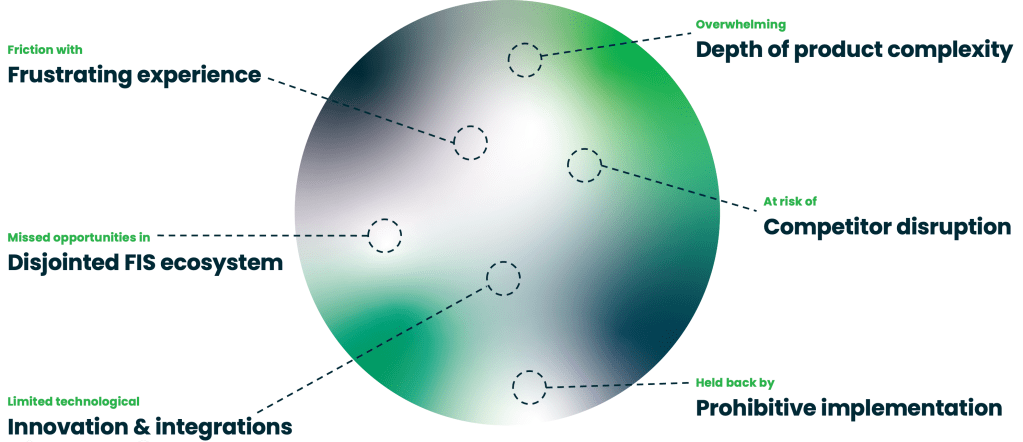
Over the past 20 years, the Payment Hub evolved from a collection of individual tools into a sprawling toolkit. Without a cohesive and consistent product vision, it turned into a labyrinth of features that are hard to navigate and adopt.
This complexity not only deters new users but also complicates sales and deployment. Custom implementations are lengthy and costly, requiring intensive efforts from FIS and customer teams to tailor the product to each customer’s needs.
The result is a solution that, while powerful, is cumbersome to use, maintain, and upgrade, making it challenging to compete in today’s market.
The project consisted of three primary stages, discovery (uncover current landscape and opportunity areas), initial experience re-design (to address the baseline usability and modernity of the product), and future product vision (to chart the path toward exponential growth).
Goal
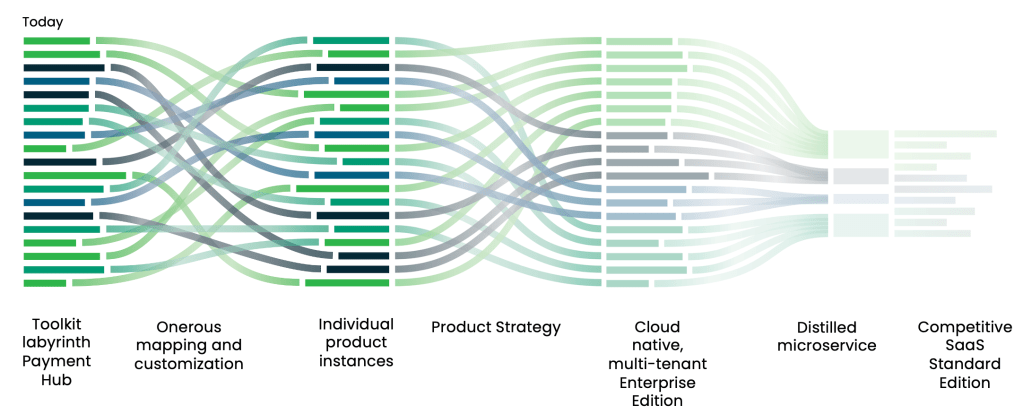
Building on the current capabilities, our goal is to map out the existing functionalities and gaps to align the product with the real needs of users and the market. Through comprehensive research and analysis, we looked to define a cohesive product strategy that transforms the toolkit into a holistic, cloud-native solution.
This shift would then translate to a more intuitive experience and reduce customization and deployment burdens, making the product easier to sell and maintain. Ultimately, this new strategy, centering the user, will deliver a more holistic platform, seamless experiences, and streamlined deployments, to ensure the product is hyper-relevant and future-proof.
To expand into new markets, we intended to further distill the full-featured product into a simplified, standard edition.
This version will extract primary, standardized functionality to provide essential less-customizable functionalities. The product offerings and limitations will be identified primarily through market research, to deliver a hyper-relevant, streamlined, easy-to-use, and cost-effective solution.
By leveraging a modular microservices architecture, this edition will be quicker to deploy, easier to maintain, and more accessible for a broader audience. This approach not only reduces the barrier to entry for cost-sensitive customers but also enhances user experience by offering a focused, precisely tailored product. Standard edition is poised to boost market penetration and drive growth.
Guiding Principles
From our user and proxy research, three core principles emerged to guide the design and evolution of the Payment Hub. First, the platform must be intuitive for every user — simple, consistent, and user-centered — enabling reductions in errors, shorter onboarding times, greater self-service, and stronger adoption.
Second, it must be catalyzed through actions, orienting the product around clear goals and actionable tasks, where intuitive workflows drive improved timeliness, higher payment success, reduced silos, easier access to relevant information, and greater visibility.
Finally, it must be engineered to evolve — modular, stable, and transformative — the tech stack itself must be built to support more integrations, scale with growing organizations, anticipate frontier technologies, and position the business for long-term resilience, disruption-proof relevance, and the ability to open new markets. Together, these principles were presented to be a guiding light for the entire team, from design through development and launch, they are the foundation for a platform that is both human-centered and future-ready.
Experience Re-Design
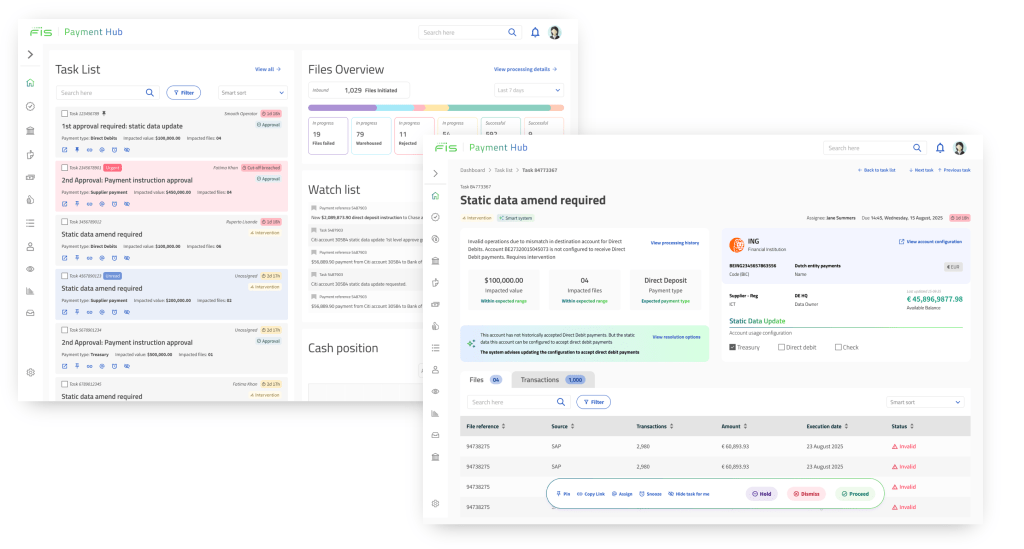
The platform was held back by an extremely out of date experience, the UI and workflows were prohibitive to basic functionality and needed to be addressed. Our design team spearheaded multiple visual approaches and experiential overhauls, allowing the client to see the variety of new approaches they could take, from this divergent exploration we established what was most important to users and FIS to create the experiential path forward.

Product Vision
We established a product vision to illustrate the path for how the current payment hub re-design project could continue to grow to meet the expansive market opportunities and combat disruption.
FIS delivers an intuitive, intelligent command center built to meet the evolving demands of modern Treasury and Finance departments.
As financial operations grow more complex, global, and dynamic, FIS empowers teams with a holistic, flexible platform that supports responsive and cohesive decision-making, real-time visibility, and deep operational insight—breaking through not only silos, but also the confusion and scale of today’s financial landscape.
Breaking it down
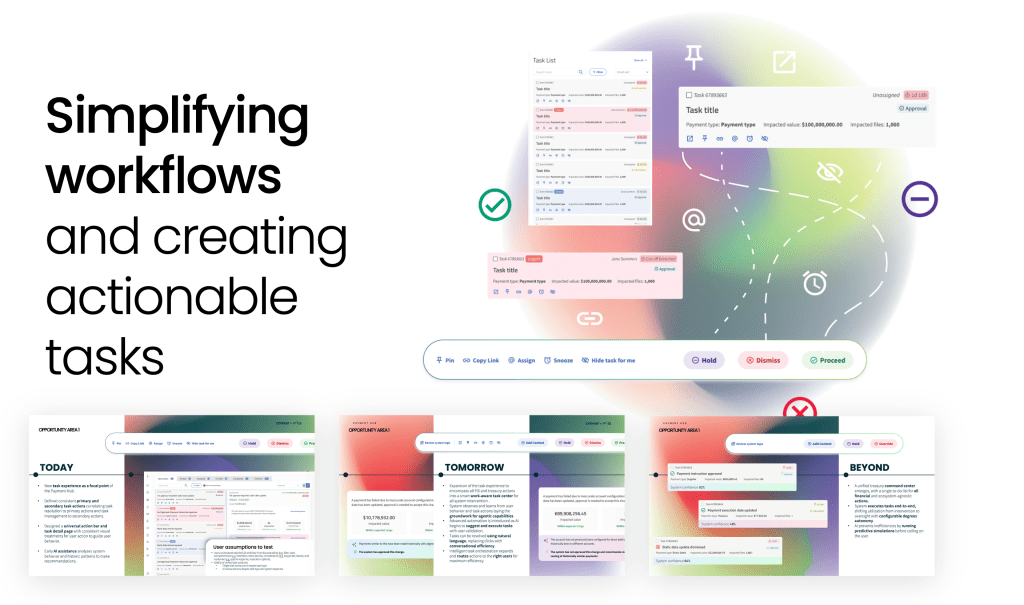
Beyond just a lofty vision in the sky we understand clients need both tangible and actionable pathways to get there, we built this via visionary milestones and specifiied opportunity areas.
We defined a set of “today, tomorrow, beyond” visionary milestones to clarify the exact focus, and required foundations to put in place along the way to build both traction and momentum in moving FIS into their future state – these served as micro-visions to ensure alignment and baseline acceptance criteria along the journey. These milestones clearly laid out the technological and experiential requirements of each phase as well as the immediate benefit upon completion (to users and business) and the foundation it laid for the phases to come.
We also made these milestones more tangible via 3 specific focus areas to ensure the vision was illustrated in terms of real use cases and attainable product capabilities.
Limitations
FIS was responsible for recruitment of their user base, this proved to be significantly more difficult than they imagined. We continuously pivoted and evolved our approach to research, preparing programs to increase participation and participant appeal via mixed-methodology, synchronous and asynchronous research, qualitative and quantitative, online and in-person, short form vs long form, etc. This adaptability did pay off in reaching their user base but admittedly we ultimately had to lean heavily on proxy-research sessions with professional services (customer success), sales, and deployment teams.

I led the FIS engagement (managing team and client) while working with Foolproof in 2025.
Our team consisted of an entirely senior team of 4 designers, 2 strategists/researchers, a product manager, a project manager, and 2 BFSI domain experts.
I worked hands on at every stage of the project, offering direct research, design, and product experience to our team to accelerate and uplift the quality of the work for all. Often leaning in at early stages to get senior team members aligned and inspired then handing ownership to them while remaining in an oversight and ad hoc support role.
Our work with FIS focused on accelerating their Payment Hub product to meet and exceed market goals. Our objective was to research, redesign, and set an innovative vision to inspire and relaunch the product.
This isn’t even the half of it.
Let’s talk specifics, I love to share my perspective and the details of my experience.
 Olivia Holland