Product definiton and development.
Accelerating AWS’s international growth and impact through user education and enablement.
Client Discovery
AWS was looking to lean into their previously established relationship with Intevity and garner new strategic results for their upcoming CloudStart initiative. Upon launching the engagement the team first needed to define the problem space for this new product. The AWS team had the ideas and insights and I led the work to gather and polish these into a strategic vision for the product.
We hosted remote and in-person workshops and working sessions with AWS stakeholders to extract intelligence from across the spectrum of internal AWS advocates and employees to external consumers. Once collected I lead the analysis process of these findings and turned around a reflection of opportunities for validation and buy-in on approach.
User Research
Once a strategic direction was defined with clear product opportunities to keep us on path we set to the work of digging deeper to clarify precise market fit. We worked with a similar group of stakeholders from AWS’s network around the world to collect data from both real and proxy users.
Users and market experts spoke to a variety of catalysis and points of friction with their current AWS experience. I led the effort in not only collecting this information but beginning to map patterns and distill actionable conclusions to inform product illumination.

Product Roadmapping
My next step was to converge user research findings into potential product features. The stakeholder groups of the discovery and research phases expressed a variety of ideas for actualized product features, some of which were relevant, some of which were infeasible but all of which informed a synthesized draft of coherent and complementary features.
Once this draft was complete we again reflected it back to the client stakeholders for validation. This process included thoughtful explanation and thorough negotiation to land upon a unified product vision for the first few years of development.
AWS Defense
AWS and wider Amazon online offerings compile an extremely vast, diverse, and ever-growing online landscape. In order to ensure their expanding online presence remains relevant and aligned all new products (especially those developed externally) must go through a User Experience Review and Product Defense process before it may proceed. This process reviews the foundational work and rationale for the product, roadmap/timeline, and UX artifacts.
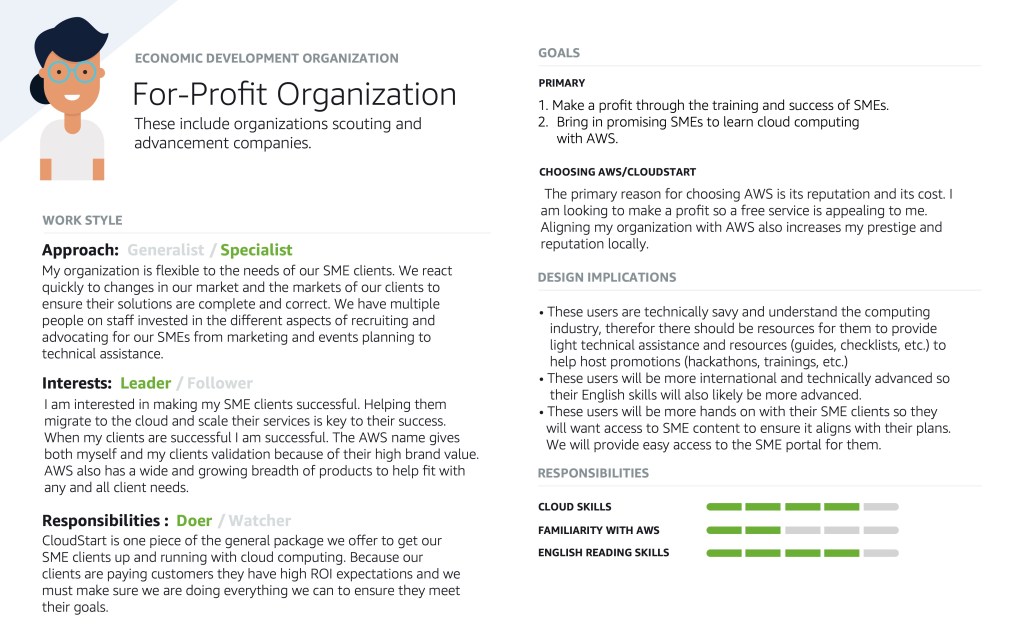
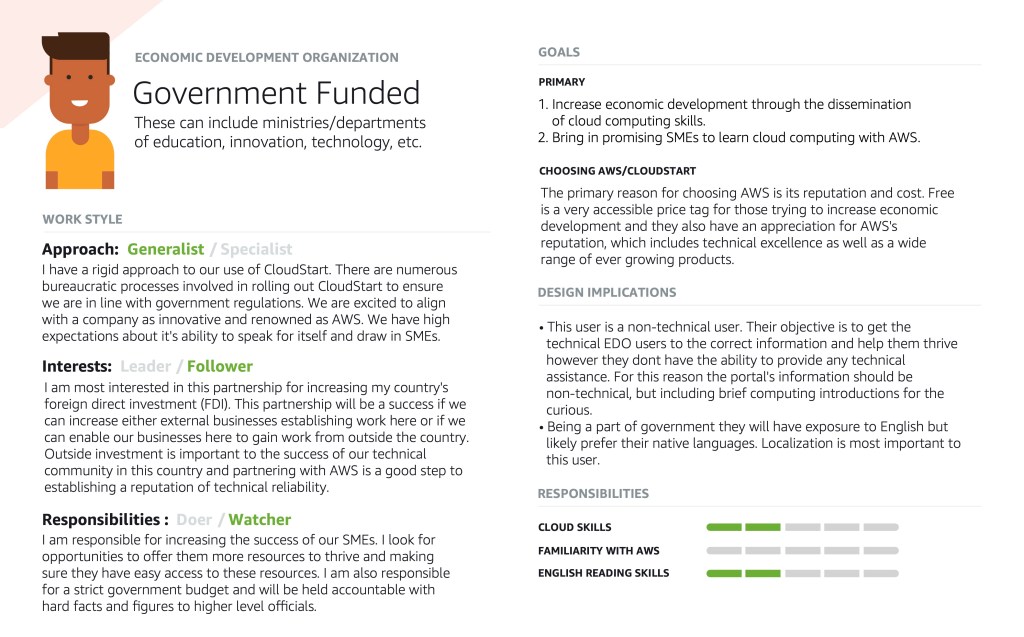
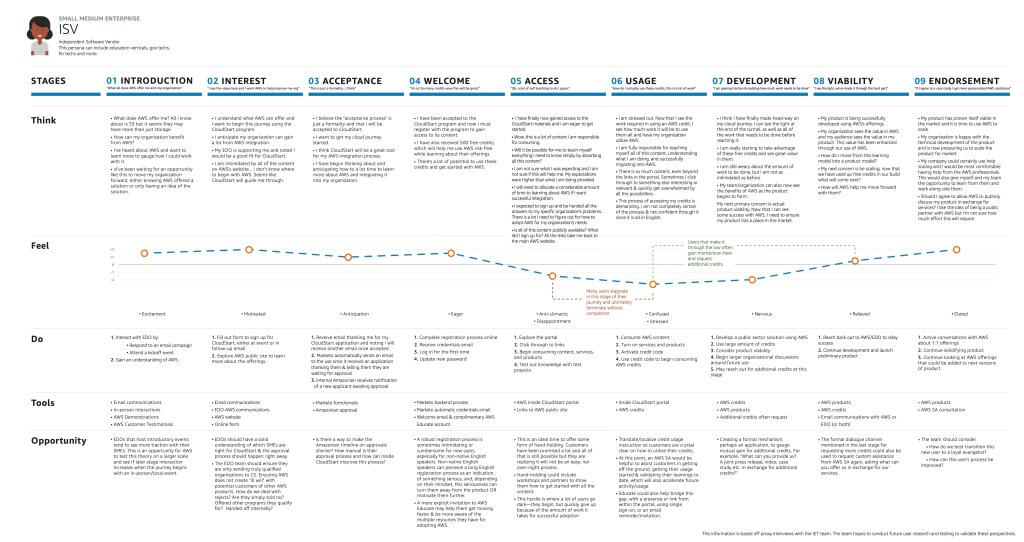
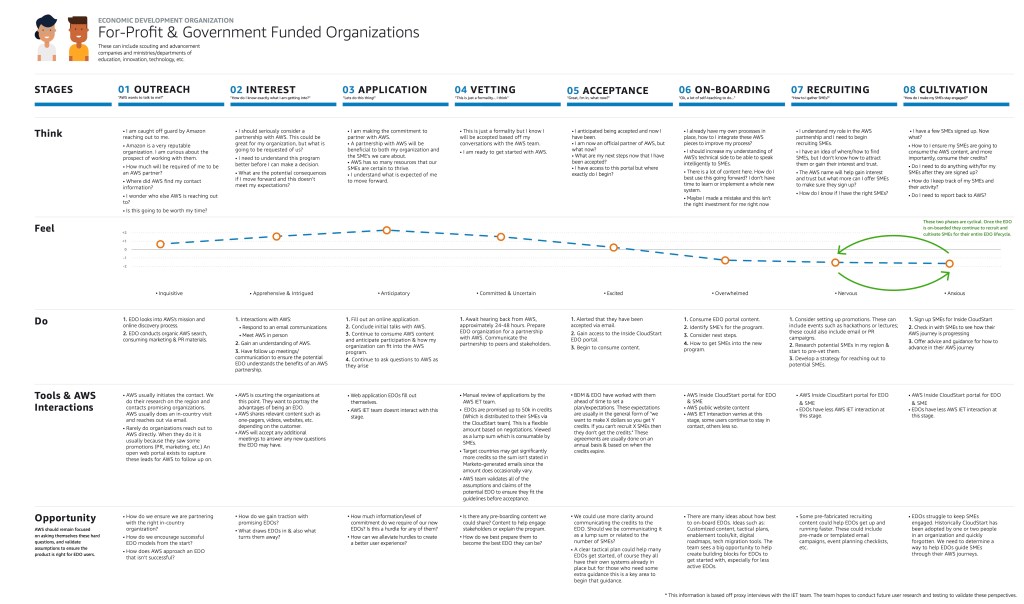
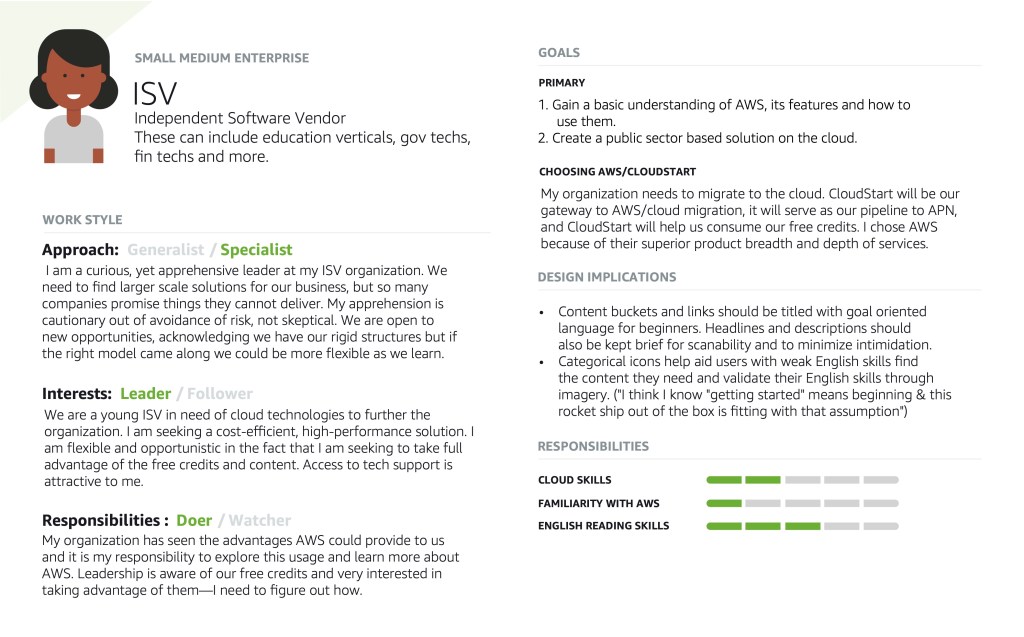
I led the creation and presentation of the team/product’s defense. Retroactively compiling documentation on problem space, market opportunity, research, and direction. As well as formalizing user research artifacts including personas and journey maps. Once presented the Amazon review board specifically noted our work as one of the most thorough and well thought out they’d seen in that review period.
This experience was foundational in my understanding and interest in systematic design operations. I gained excellent exposure to how massive organizations, like AWS/Amazon, institutionalize design thinking standards. I later leaned upon this to work to develop our own design thinking and operations practice at Intevity.
Prototyping
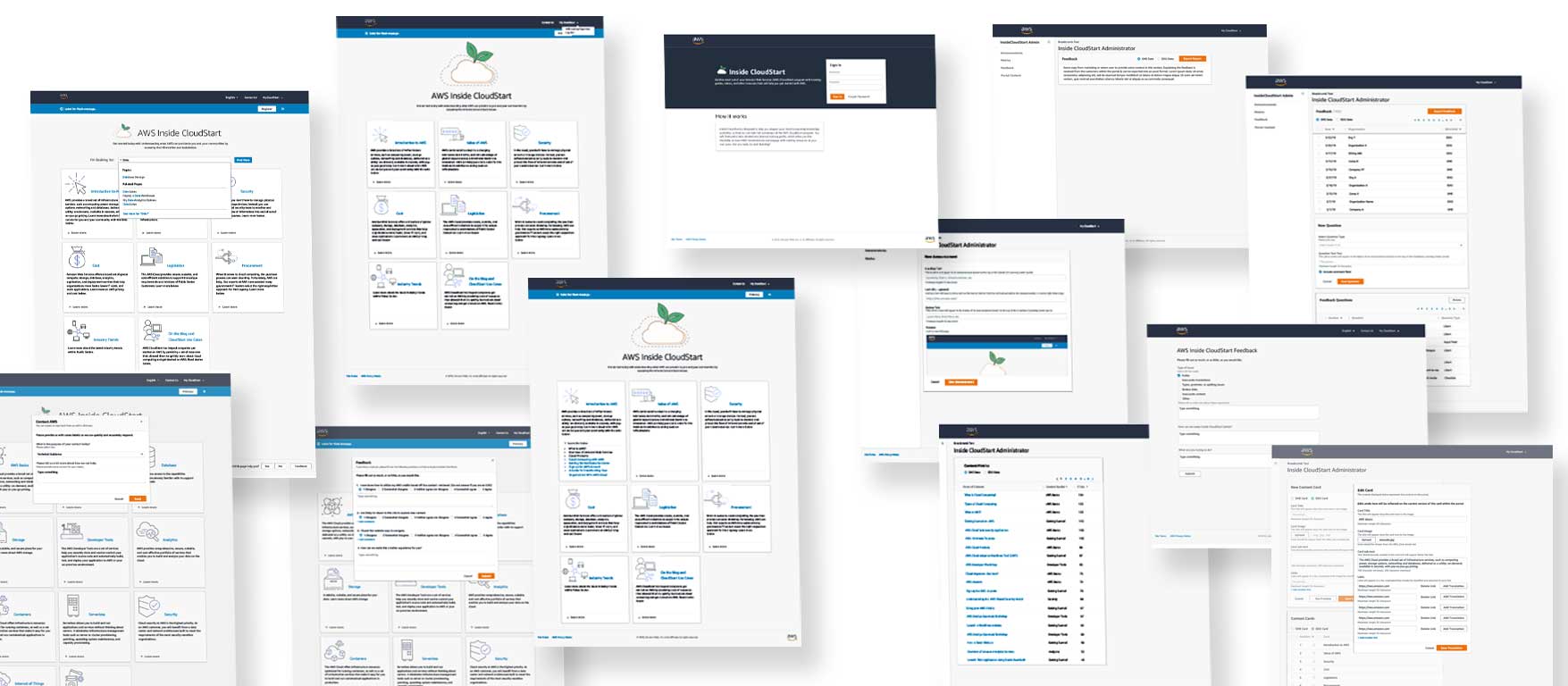
The Amazon online ecosystem is built upon a robust design system called Polaris. As we moved into the interface design phase I was responsible for ramping up on and designing within their strict and well-defined guidelines. Extensive documentation was available in Sketch files as well as in an interactive intranet site.
This experience gave me first-hand exposure to how large organizations/ecosystems design, document, and maintain extremely substantial and comprehensive design systems. I later leaned upon this exposure to develop design systems for other clients and products.

User Testing
Once the interactions and interfaces were initially designed we tested the solution with real and proxy users. Testing took place on-site at Amazon’s DC offices. We used high-fidelity clickable prototypes and task prompts to gauge design success.
The findings from this process mostly supported the initial design decisions and clarified spaces for additional design iteration.
Development
The development team was exposed, if not involved, in all previous steps of product discovery and therefore well-positioned to begin development work once the solution had solidified. I provided the team with video demo recordings, high-fidelity clickable prototypes, and extensive design documentation. Due to the nature of designing within Polaris I only provided light documentation on components and mainly focused on documenting functionality, page layouts, interactions, and responsiveness.
I led the AWS engagement while working with Intevity in 2018 and 2019. Our work with AWS focused on accelerating their Amazon Web Services Worldwide Public Sector initiative. Our objective was to define, design, and develop a new product for their Cloudstart program.
Intevity created a strategy and findings document for us after leading our team through 2-day workshop focused on accelerating our international sales process. I’ve been through a number of workshops over the years, but this was the first time I’ve seen a document of this quality coming out of it.
Head of Expansion and Capture, John Brennan
This isn’t even the half of it.
Let’s talk specifics, I love to share my perspective and the details of my experience.
 Olivia Holland